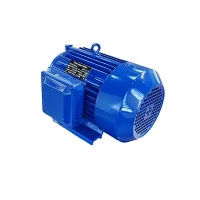
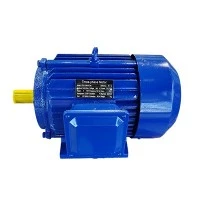
Hey there! As a supplier of AC current motors, I often get asked about how different braking methods work in these motors. One method that's quite interesting and useful is plugging braking. So, let's dive into how plugging braking works in an AC current motor.
First off, let's quickly understand what an AC current motor is. An Alternating Current AC Motor is a type of electric motor that runs on alternating current. These motors are widely used in various industrial and commercial applications because they're reliable, efficient, and can handle different loads.
Now, what is plugging braking? Well, plugging braking is a method used to quickly stop an AC motor. It's also known as reverse current braking. The basic idea behind plugging braking is to reverse the phase sequence of the stator's magnetic field. When you do this, the motor's rotor suddenly experiences a torque in the opposite direction of its rotation. This opposing torque acts like a brake, slowing down the motor rapidly.
Let's break down the process step by step. In a normal operating AC motor, the stator windings create a rotating magnetic field. This rotating magnetic field interacts with the rotor, causing it to rotate in the same direction as the magnetic field. The speed of the rotor is determined by the frequency of the AC power supply and the number of poles in the motor.
When we want to apply plugging braking, we change the phase sequence of the stator's magnetic field. This can be done by reversing the connections of two of the three phases in a three - phase AC motor. Once the phase sequence is reversed, the new rotating magnetic field rotates in the opposite direction of the rotor's current rotation.
As the rotor continues to rotate in its original direction, it now cuts through the reversed magnetic field. According to Faraday's law of electromagnetic induction, this relative motion between the rotor and the reversed magnetic field induces an electromotive force (EMF) in the rotor. This induced EMF causes a current to flow in the rotor conductors.
The interaction between the current in the rotor conductors and the reversed magnetic field creates a torque that opposes the rotor's motion. This opposing torque is what slows down the motor. The magnitude of this braking torque depends on several factors, such as the strength of the reversed magnetic field, the resistance of the rotor circuit, and the speed of the rotor.
One important thing to note is that during plugging braking, the motor acts like a generator for a short period. The kinetic energy of the rotating rotor is converted into electrical energy. This electrical energy is dissipated as heat in the motor's windings and the external braking resistors (if used).
However, plugging braking has its pros and cons. On the positive side, it's a very effective way to stop a motor quickly. It can bring a motor to a halt in a matter of seconds, which is useful in applications where rapid stopping is required, such as in some conveyor systems or machine tools.
But there are also some drawbacks. One major issue is the high current that flows through the motor during plugging braking. This high current can cause excessive heating in the motor windings, which may damage the insulation and reduce the motor's lifespan. To mitigate this problem, external braking resistors are often used. These resistors are connected in series with the motor windings to limit the current flow and dissipate the excess energy as heat.
Another drawback is that plugging braking can cause mechanical stress on the motor and the connected load. The sudden change in torque can lead to vibrations and wear on the motor's bearings and other mechanical components. So, it's important to use plugging braking carefully and make sure the motor and the load can withstand the stress.
Now, let's talk about some of the applications where plugging braking is commonly used. In industrial settings, it's used in cranes and hoists. When a crane operator needs to stop the hoisting or lowering of a load quickly, plugging braking can be applied to bring the motor to a halt rapidly. It's also used in some conveyor systems where products need to be stopped at specific positions.
At our company, we offer a wide range of AC current motors that are suitable for plugging braking applications. For example, our Waterproof AC Motor is designed to work in harsh environments and can handle the stress of plugging braking. Our 3 Phase 110V Motor is also a great option for various applications, providing reliable performance with the option of plugging braking.
If you're in the market for an AC current motor and need a motor that can use plugging braking effectively, we're here to help. We have a team of experts who can assist you in choosing the right motor for your specific application. Whether you need a motor for a small workshop or a large industrial plant, we have the products and the knowledge to meet your needs.
So, if you're interested in learning more about our AC current motors or want to discuss your requirements for plugging braking applications, don't hesitate to reach out. We're always happy to have a chat and help you find the best solution for your business.


References:
- Electric Machinery Fundamentals by Stephen J. Chapman
- Electrical Machines and Drives by I. J. Nagrath and D. P. Kothari