As a supplier of AC series motors, I often encounter questions from customers about various technical aspects of these motors. One of the frequently asked questions is about the power factor of an AC series motor. In this blog, I'll delve into what the power factor of an AC series motor is, its significance, and how it impacts motor performance.
Understanding the Basics of AC Series Motors
Before we dive into the power factor, let's briefly understand what an AC series motor is. An AC series motor is a type of electric motor that operates on alternating current (AC). It has a construction similar to a DC series motor, with the field winding and the armature winding connected in series. This configuration allows the motor to have high starting torque, which makes it suitable for applications where a large amount of torque is required at startup, such as in vacuum cleaners, power tools, and some traction systems.


What is Power Factor?
Power factor (PF) is a measure of how effectively electrical power is being used in an AC circuit. In an AC system, the power can be divided into two components: real power (P), which is the power that actually does useful work (like turning a motor shaft), and reactive power (Q), which is the power that oscillates between the source and the load without doing any useful work. The apparent power (S) is the combination of real and reactive power and is given by the formula (S=\sqrt{P^{2} + Q^{2}}).
The power factor is defined as the ratio of real power to apparent power, i.e., (PF=\frac{P}{S}). It is a dimensionless quantity that ranges from 0 to 1. A power factor of 1 indicates that all the electrical power supplied to the circuit is being used for useful work, while a power factor less than 1 means that some of the power is being wasted in the form of reactive power.
Power Factor of an AC Series Motor
The power factor of an AC series motor is typically relatively low, especially at low speeds. This is mainly due to the high inductance of the field and armature windings. Inductance causes the current to lag behind the voltage in an AC circuit, resulting in a phase difference between the voltage and current waveforms. The greater the phase difference, the lower the power factor.
When an AC series motor is operating at low speeds, the reactance of the windings is relatively high compared to their resistance. This high reactance causes a large phase shift between the voltage and current, leading to a low power factor. As the speed of the motor increases, the resistance of the windings becomes more dominant, and the phase shift between the voltage and current decreases, resulting in an improvement in the power factor.
Significance of Power Factor in AC Series Motors
The power factor of an AC series motor has several important implications:
Energy Efficiency
A low power factor means that a significant amount of electrical power is being wasted as reactive power. This not only increases the energy consumption of the motor but also leads to higher electricity bills for the user. By improving the power factor, more of the supplied electrical power can be used for useful work, resulting in better energy efficiency.
Equipment Capacity
Utilities often charge industrial and commercial customers based on their apparent power consumption rather than just real power. A low power factor means that a customer is drawing more apparent power from the grid than is actually needed for useful work. This can lead to higher demand charges and may also require the utility to install larger transformers and other equipment to meet the customer's apparent power requirements.
Motor Performance
A low power factor can also affect the performance of the AC series motor itself. It can cause the motor to run hotter than normal due to the increased current flow required to deliver the same amount of real power. This can reduce the motor's efficiency and lifespan and may also lead to premature failure of the motor windings.
Improving the Power Factor of an AC Series Motor
There are several ways to improve the power factor of an AC series motor:
Capacitor Compensation
One of the most common methods is to use capacitor banks to provide reactive power compensation. Capacitors generate reactive power that is opposite in phase to the reactive power consumed by the motor's inductive windings. By connecting a capacitor bank in parallel with the motor, the overall reactive power demand of the system can be reduced, resulting in an improvement in the power factor.
Motor Design
Improvements in motor design can also help to increase the power factor. For example, using high - quality magnetic materials in the field and armature windings can reduce the inductance and thus the phase shift between the voltage and current. Additionally, optimizing the winding configuration and the number of turns can also have a positive impact on the power factor.
Our Offerings as an AC Series Motor Supplier
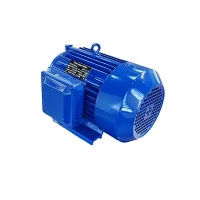
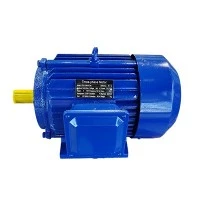
As a leading supplier of AC series motors, we understand the importance of power factor and its impact on motor performance and energy efficiency. Our motors are designed with the latest technologies to ensure optimal power factor and performance. We offer a wide range of AC series motors suitable for various applications, including 3 Phase 110V Motor, AC Three Phase Induction Motor, and AC Squirrel Cage Induction Motor.
Our engineering team is constantly working on research and development to improve the power factor and overall efficiency of our motors. We also provide technical support to our customers to help them select the right motor for their specific applications and to optimize the motor's performance.
Contact Us for Procurement
If you are in the market for high - quality AC series motors with excellent power factor and performance, we invite you to contact us for procurement. Our sales team is ready to assist you in finding the perfect motor solution for your needs. Whether you are looking for a motor for a small power tool or a large industrial application, we have the expertise and the products to meet your requirements.
References
- Fitzgerald, A. E., Kingsley, C., & Umans, S. D. (2003). Electric Machinery (6th ed.). McGraw - Hill.
- Chapman, S. J. (2012). Electric Machinery Fundamentals (5th ed.). McGraw - Hill.
- Krause, P. C., Wasynczuk, O., & Sudhoff, S. D. (2013). Analysis of Electric Machinery and Drive Systems (3rd ed.). Wiley.