As a supplier of AC forklift motors, I've witnessed firsthand the critical role these motors play in the material handling industry. In this blog, I'll delve into the inner workings of an AC forklift motor, exploring its components, operation principles, and advantages.
Components of an AC Forklift Motor
An AC forklift motor is a complex piece of machinery composed of several key components. At the heart of the motor is the stator, which is the stationary part. The stator consists of a series of windings made of copper wire. These windings are arranged in a specific pattern to create a rotating magnetic field when an alternating current (AC) is applied.
The rotor is the rotating part of the motor. It is typically made of laminated steel sheets to reduce eddy current losses. The rotor can be either a squirrel - cage rotor or a wound rotor. In most AC forklift motors, the squirrel - cage rotor is commonly used due to its simplicity, reliability, and low cost. The squirrel - cage rotor consists of a set of conductive bars short - circuited at both ends by end rings, resembling a squirrel cage.
Another important component is the motor housing, which provides mechanical support and protection for the internal components. It also helps in dissipating heat generated during the motor's operation. Bearings are used to support the rotor and allow it to rotate smoothly within the housing. Additionally, there are cooling fans or other cooling mechanisms to prevent the motor from overheating.
How an AC Forklift Motor Works
The operation of an AC forklift motor is based on the principle of electromagnetic induction. When an AC voltage is applied to the stator windings, an alternating current flows through them. This current creates a magnetic field that alternates in direction and magnitude.
The rotating magnetic field produced by the stator cuts across the conductive bars of the squirrel - cage rotor. According to Faraday's law of electromagnetic induction, an electromotive force (EMF) is induced in the rotor bars. This induced EMF causes a current to flow in the rotor bars.
The interaction between the magnetic field of the stator and the current - carrying rotor bars creates a torque. This torque causes the rotor to rotate in the same direction as the rotating magnetic field of the stator. The speed of the rotating magnetic field is determined by the frequency of the AC power supply and the number of poles in the stator windings. The formula for the synchronous speed (n_s) is given by:
(n_s=\frac{120f}{p})
where (f) is the frequency of the AC power supply (in Hz) and (p) is the number of poles in the stator windings.
However, the actual speed of the rotor, known as the slip speed, is slightly less than the synchronous speed. The difference between the synchronous speed and the actual speed is called the slip. The slip is necessary for the induction of current in the rotor and the generation of torque.
Types of AC Forklift Motors
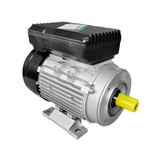
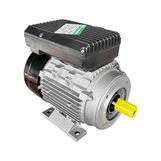
There are several types of AC motors used in forklifts. One common type is the Dual Shaft AC Motor. This motor has two output shafts, which can be used to drive different components of the forklift simultaneously. For example, one shaft can be used to drive the wheels, while the other can be used to power the hydraulic pump for lifting and lowering the forks.
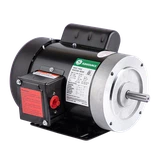
Another type is the 3 Phase AC Induction Motor. Three - phase AC motors are widely used in industrial applications, including forklifts, due to their high efficiency, reliability, and smooth operation. They are capable of producing a more uniform rotating magnetic field compared to single - phase motors, resulting in better performance.
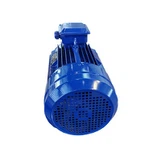
The AC Three Phase Induction Motor is also a popular choice for forklifts. It operates on the same principle as the 3 - phase AC induction motor but may have different design features and performance characteristics depending on the specific application requirements.
Advantages of AC Forklift Motors
AC forklift motors offer several advantages over their DC counterparts. One of the main advantages is higher efficiency. AC motors convert electrical energy into mechanical energy more efficiently, which means less energy is wasted as heat. This results in lower operating costs and longer battery life for electric forklifts.
AC motors also have better speed control. They can be easily controlled using variable frequency drives (VFDs). VFDs allow for precise adjustment of the motor's speed, torque, and acceleration, which is crucial for the smooth and efficient operation of forklifts. This enables operators to handle different loads and perform various tasks with greater precision.
In addition, AC forklift motors require less maintenance. They have fewer moving parts compared to DC motors, which reduces the risk of mechanical failure. The absence of brushes in AC motors eliminates the need for brush replacement and reduces the generation of electrical sparks, making them safer to operate in hazardous environments.
Applications of AC Forklift Motors
AC forklift motors are used in a wide range of applications in the material handling industry. They are commonly found in warehouses, distribution centers, manufacturing plants, and ports. In warehouses, forklifts equipped with AC motors are used for tasks such as loading and unloading pallets, stacking goods on shelves, and transporting materials within the facility.
In manufacturing plants, AC forklift motors are used to move raw materials, work - in - progress, and finished products between different production areas. They are also used in ports for handling containers and other heavy cargo.
Conclusion
In conclusion, AC forklift motors are essential components in the material handling industry. Their operation is based on the principle of electromagnetic induction, and they offer numerous advantages such as high efficiency, better speed control, and low maintenance. As a supplier of AC forklift motors, we are committed to providing high - quality products that meet the diverse needs of our customers.
If you are in the market for AC forklift motors or have any questions about our products, we encourage you to contact us for procurement and further discussion. Our team of experts is ready to assist you in finding the right motor for your specific application.


References
- Fitzgerald, A. E., Kingsley, C., & Umans, S. D. (2003). Electric Machinery. McGraw - Hill.
- Chapman, S. J. (2012). Electric Machinery Fundamentals. McGraw - Hill.