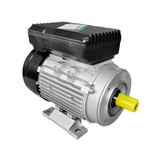
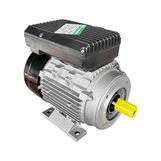
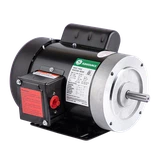
As a long - standing 120V AC motor supplier, I've had the privilege of working closely with these remarkable pieces of machinery. Over the years, I've witnessed their applications in various industries, from small household appliances to more complex industrial setups. In this blog, I'll delve into the different parts of a 120V AC motor, explaining their functions and importance.
Stator
The stator is the stationary part of the 120V AC motor. It consists of a laminated iron core and stator windings. The laminated iron core is made up of thin sheets of iron, which are stacked together. This design helps to reduce eddy current losses, a type of energy loss that occurs when magnetic fields induce currents in the core.
The stator windings are coils of wire that are wound around the stator core. When an alternating current (AC) is applied to these windings, a rotating magnetic field is created. This rotating magnetic field is the key to the motor's operation, as it interacts with the magnetic field of the rotor to produce torque.
The strength and characteristics of the rotating magnetic field depend on the number of windings, the way they are connected, and the frequency of the applied AC voltage. In a 120V AC motor, the standard frequency in many regions is 60 Hz, which affects the speed and performance of the motor. For more information on different types of single - phase AC motors, you can visit our Single AC Motor page.
Rotor
The rotor is the rotating part of the motor. There are different types of rotors, but in a typical 120V AC motor, we often encounter the squirrel - cage rotor. The squirrel - cage rotor consists of a laminated iron core with conductive bars embedded in it. These bars are short - circuited at both ends by end rings, forming a structure that resembles a squirrel cage.
When the rotating magnetic field of the stator cuts across the conductive bars of the rotor, an electromotive force (EMF) is induced in the bars according to Faraday's law of electromagnetic induction. This induced EMF causes a current to flow in the bars. The interaction between the current in the bars and the stator's magnetic field creates a torque that makes the rotor rotate.
The rotor's design and construction are crucial for the motor's efficiency and performance. A well - designed squirrel - cage rotor can provide smooth and reliable operation, with minimal mechanical losses. Another type of rotor is used in Universal Motor Single Phase motors, which have a different construction to accommodate both AC and DC power sources.
Bearings
Bearings play a vital role in the operation of a 120V AC motor. They support the rotor and allow it to rotate smoothly with minimal friction. There are two main types of bearings used in motors: ball bearings and sleeve bearings.
Ball bearings consist of balls that roll between an inner and an outer race. They are known for their low friction and high - speed capabilities. Ball bearings are often used in motors that require high - precision operation and high - speed rotation.
Sleeve bearings, on the other hand, use a cylindrical sleeve that provides a sliding surface for the rotor shaft. They are simpler in design and can be more cost - effective. However, they may require more maintenance and are generally better suited for lower - speed applications.
Proper lubrication is essential for both types of bearings to ensure their longevity and performance. Over time, bearings can wear out due to factors such as vibration, temperature, and load. Regular inspection and replacement of bearings can prevent motor failures and ensure continuous operation.
Capacitor
In many 120V single - phase AC motors, a capacitor is used to improve the motor's starting torque and running efficiency. Single - phase motors do not have a naturally rotating magnetic field like three - phase motors. A capacitor creates a phase shift in the current flowing through one of the stator windings, effectively creating a more rotating - like magnetic field.
There are two main types of capacitors used in motors: start capacitors and run capacitors. Start capacitors are designed to provide a high initial torque to start the motor. They are usually larger in capacitance and are only used during the starting process. Once the motor reaches a certain speed, a centrifugal switch disconnects the start capacitor from the circuit.


Run capacitors, on the other hand, remain in the circuit during the motor's operation. They help to improve the motor's power factor and efficiency by providing a more balanced magnetic field. The choice of capacitor depends on the motor's design and specifications. For more details on our 120V AC Motor products, which may include different capacitor configurations, you can visit our dedicated page.
Centrifugal Switch
As mentioned earlier, the centrifugal switch is an important part of some 120V AC motors, especially those with start capacitors. The centrifugal switch is connected to the motor's shaft and operates based on the rotational speed of the motor.
When the motor is at rest or running at a low speed, the centrifugal switch is closed, allowing the start capacitor to be connected to the circuit. This provides the necessary phase shift and high starting torque. As the motor speeds up, the centrifugal force acting on the switch causes it to open, disconnecting the start capacitor from the circuit.
The proper functioning of the centrifugal switch is crucial for the motor's performance. If the switch fails to open or close at the right time, it can lead to problems such as excessive current draw, overheating, and reduced motor efficiency. Regular inspection and maintenance of the centrifugal switch can help prevent these issues.
Enclosure
The enclosure of a 120V AC motor serves several important functions. Firstly, it protects the internal components of the motor from dust, dirt, moisture, and other environmental factors. This helps to extend the motor's lifespan and prevent damage to the windings, bearings, and other parts.
Secondly, the enclosure provides mechanical protection for the motor. It can withstand impacts and vibrations, ensuring that the motor remains intact during operation. There are different types of enclosures, such as open - drip - proof (ODP), totally enclosed fan - cooled (TEFC), and explosion - proof enclosures.
The choice of enclosure depends on the application and the environment in which the motor will be used. For example, in a dusty industrial environment, a TEFC enclosure may be more suitable, while in a hazardous area where there is a risk of explosions, an explosion - proof enclosure is required.
Terminal Box
The terminal box is where the electrical connections are made to the motor. It provides a safe and accessible location for connecting the power supply wires to the motor's windings. Inside the terminal box, there are terminals that are marked to indicate the correct connection points.
Proper wiring and connection in the terminal box are essential for the motor's safe and efficient operation. Incorrect wiring can lead to issues such as motor overheating, reversed rotation, and electrical hazards. It is important to follow the manufacturer's wiring diagrams and instructions when making the connections.
Conclusion
In conclusion, a 120V AC motor is a complex piece of machinery that consists of several important parts, each with its own unique function. The stator creates the rotating magnetic field, the rotor rotates in response to this field, and the bearings support the rotation. Capacitors improve starting torque and efficiency, and the centrifugal switch controls the start capacitor. The enclosure protects the motor, and the terminal box provides a safe connection point.
As a 120V AC motor supplier, we understand the importance of these components and ensure that our motors are designed and manufactured to the highest standards. If you are in the market for a reliable 120V AC motor, we invite you to contact us for more information and to discuss your specific requirements. Our team of experts is ready to assist you in finding the right motor for your application.
References
- Chapman, S. J. (2012). Electric Machinery Fundamentals. McGraw - Hill Education.
- Fitzgerald, A. E., Kingsley Jr, C., & Umans, S. D. (2003). Electric Machinery. McGraw - Hill.