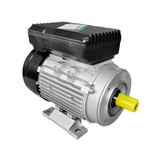
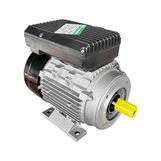
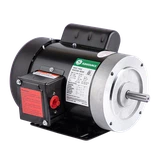
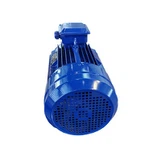
As a supplier of 3 Phase 110V Motors, I often encounter inquiries about the speed of these motors. Understanding the speed characteristics of a 3 Phase 110V Motor is crucial for various industrial and commercial applications. In this blog, I'll delve into the factors that determine the speed of such motors, the different types of 3 Phase 110V Motors and their speed ranges, and how to select the right motor speed for your specific needs.
Understanding the Basics of 3 Phase 110V Motors
Before we discuss the speed, let's briefly understand what a 3 Phase 110V Motor is. A three - phase motor is a type of Three Phase AC Motor that operates on a three - phase power supply. The 110V indicates the voltage at which the motor is designed to run. Three - phase power is more efficient and provides a smoother power delivery compared to single - phase power, making these motors popular in many industrial and commercial settings.
These motors are part of the broader category of Alternating Current AC Motor. They work based on the principle of electromagnetic induction, where a rotating magnetic field is created by the three - phase power supply, which in turn causes the rotor of the motor to rotate.
Factors Affecting the Speed of a 3 Phase 110V Motor
The speed of a 3 Phase 110V Motor is influenced by several factors:
1. Number of Poles
The number of poles in a motor is one of the primary factors determining its synchronous speed. The synchronous speed ($N_s$) of an AC motor can be calculated using the formula:
$N_s=\frac{120f}{P}$
where $f$ is the frequency of the power supply (in Hz) and $P$ is the number of poles. In most regions, the standard power supply frequency is either 50Hz or 60Hz. For example, in a 6 - pole motor operating on a 60Hz power supply, the synchronous speed would be:
$N_s=\frac{120\times60}{6}=1200$ RPM
2. Slip
In an induction motor, the actual speed of the rotor is always less than the synchronous speed. The difference between the synchronous speed and the actual speed is called slip. Slip occurs because the rotor must cut the magnetic field lines in order to generate torque. The slip ($s$) is calculated as:
$s=\frac{N_s - N_r}{N_s}$
where $N_r$ is the actual rotor speed. The amount of slip depends on the load on the motor. As the load increases, the slip also increases, and the actual speed of the motor decreases.
3. Frequency of the Power Supply
The frequency of the power supply directly affects the synchronous speed of the motor. As seen in the formula for synchronous speed, an increase in frequency will result in an increase in the synchronous speed, assuming the number of poles remains constant.
Types of 3 Phase 110V Motors and Their Speed Ranges
AC Squirrel Cage Induction Motor
One of the most common types of 3 Phase 110V Motors is the AC Squirrel Cage Induction Motor. These motors are known for their simplicity, reliability, and low cost.
The speed of a squirrel - cage induction motor is relatively stable under normal operating conditions. For a 4 - pole squirrel - cage induction motor operating on a 60Hz power supply, the synchronous speed is 1800 RPM. With a typical slip of around 2 - 5%, the actual operating speed would be in the range of 1710 - 1764 RPM.
Wound Rotor Induction Motor
Wound rotor induction motors offer more flexibility in speed control compared to squirrel - cage induction motors. By adding external resistance to the rotor circuit, the slip can be increased, which allows for a wider range of speed control. However, these motors are more complex and expensive than squirrel - cage motors.
Synchronous Motors
Synchronous motors run at the synchronous speed and do not have slip under normal operating conditions. They are used in applications where a constant speed is required, such as in precision machinery and some industrial processes. The speed of a synchronous 3 Phase 110V Motor is determined solely by the frequency of the power supply and the number of poles.


Selecting the Right Speed for Your Application
When choosing a 3 Phase 110V Motor for your application, it's important to consider the required speed. Here are some factors to keep in mind:
Load Requirements
The type of load the motor will be driving is a crucial factor. For example, a conveyor belt may require a relatively constant speed, while a mixer may need variable speed control. If the load has high inertia, such as a large flywheel, a motor with a higher starting torque and appropriate speed characteristics may be needed.
Efficiency
Selecting a motor with the right speed can also improve energy efficiency. A motor operating at its optimal speed will consume less power and have a longer lifespan.
Speed Control
If your application requires variable speed control, you may need to choose a motor that can be easily controlled, such as a wound rotor induction motor or a motor with a variable frequency drive (VFD). A VFD allows you to adjust the frequency of the power supply to the motor, which in turn changes the speed of the motor.
Conclusion
The speed of a 3 Phase 110V Motor is determined by several factors, including the number of poles, slip, and the frequency of the power supply. Different types of 3 Phase 110V Motors, such as squirrel - cage induction motors, wound rotor induction motors, and synchronous motors, have different speed characteristics and are suitable for different applications.
As a supplier of 3 Phase 110V Motors, I understand the importance of selecting the right motor for your specific needs. Whether you need a motor for a simple conveyor system or a complex industrial process, I can help you choose the motor with the appropriate speed and performance. If you're interested in learning more about our 3 Phase 110V Motors or would like to discuss your specific requirements, please feel free to contact us for a detailed consultation. We're committed to providing high - quality motors and excellent customer service to meet your industrial and commercial needs.
References
- Fitzgerald, A. E., Kingsley, C., & Umans, S. D. (2003). Electric Machinery. McGraw - Hill.
- Chapman, S. J. (2012). Electric Machinery Fundamentals. McGraw - Hill.