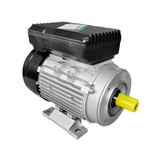
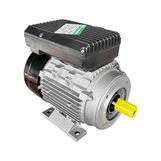
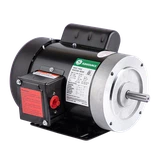
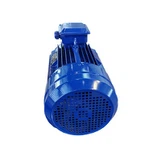
Hey there! As a supplier of alternating motors, I often get asked about the frequency requirements for these motors. So, I thought I'd take a few minutes to break it down for you.
First off, let's talk about what alternating motors are. Alternating motors, also known as AC motors, are widely used in various industries due to their efficiency, reliability, and versatility. They work by using alternating current to create a rotating magnetic field, which in turn drives the motor's shaft.
Now, when it comes to frequency requirements, it's important to understand that the frequency of the alternating current (AC) power supply plays a crucial role in the performance of the motor. The frequency is measured in Hertz (Hz), which represents the number of cycles per second. In most parts of the world, the standard frequency for AC power is either 50 Hz or 60 Hz.
So, why does the frequency matter? Well, the speed of an AC motor is directly related to the frequency of the power supply. The relationship between the motor speed (in revolutions per minute, RPM), the frequency (in Hz), and the number of poles in the motor is given by the following formula:
[ RPM=\frac{120\times Frequency}{Number\ of\ Poles} ]
This formula shows that for a given number of poles, the motor speed increases with an increase in frequency. For example, a 4 - pole motor operating on a 50 Hz power supply will have a synchronous speed of:
[ RPM=\frac{120\times50}{4}=1500\ RPM ]
If the same motor is operated on a 60 Hz power supply, the synchronous speed will be:
[ RPM=\frac{120\times60}{4}=1800\ RPM ]
This means that if you want to change the speed of an AC motor, you can either change the number of poles (which is not always practical) or change the frequency of the power supply.


Now, let's look at some specific types of alternating motors and their frequency requirements.
3 Phase AC Electric Motor
A 3 Phase AC Electric Motor is one of the most common types of AC motors. These motors are used in a wide range of applications, from industrial machinery to HVAC systems.
Most 3 - phase AC electric motors are designed to operate at either 50 Hz or 60 Hz. When selecting a 3 - phase AC motor, it's important to make sure that the motor is rated for the frequency of your local power supply. Using a motor designed for 50 Hz on a 60 Hz power supply can cause the motor to run at a higher speed than intended, which can lead to increased wear and tear, overheating, and even motor failure. Conversely, using a 60 Hz motor on a 50 Hz power supply will result in a lower motor speed, which may not be sufficient for the application.
3 Phase 110V Motor
A 3 Phase 110V Motor is a type of 3 - phase motor that is designed to operate at a voltage of 110 volts. These motors are often used in small - scale industrial applications or in regions where the local power supply is 110V.
Like other 3 - phase motors, 3 - phase 110V motors have specific frequency requirements. It's crucial to match the motor's frequency rating with the frequency of the power supply. Otherwise, you may experience issues such as reduced motor performance, increased energy consumption, and potential damage to the motor.
AC Three Phase Induction Motor
The AC Three Phase Induction Motor is another popular type of AC motor. It works on the principle of electromagnetic induction, where the rotating magnetic field created by the stator induces a current in the rotor, causing it to rotate.
AC three - phase induction motors are also designed to operate at specific frequencies. The frequency affects not only the motor speed but also the motor's torque - speed characteristics. For example, at a lower frequency, the motor may have higher starting torque but lower maximum speed. At a higher frequency, the motor will have a higher maximum speed but may have reduced starting torque.
In some cases, you may need to use a variable frequency drive (VFD) to control the frequency of the power supply to the motor. A VFD allows you to adjust the frequency and voltage of the AC power supplied to the motor, which in turn allows you to control the motor speed and torque. This can be very useful in applications where you need to vary the motor speed, such as in conveyor systems, pumps, and fans.
When choosing an alternating motor, it's important to consider the frequency requirements of your application. Here are some tips to help you make the right choice:
- Know your power supply: Check the frequency of your local power supply. In most countries, it's either 50 Hz or 60 Hz. Make sure the motor you choose is rated for this frequency.
- Understand your application requirements: Consider the speed, torque, and power requirements of your application. If you need to vary the motor speed, a VFD - compatible motor may be a good option.
- Consult with an expert: If you're not sure which motor is right for your application, don't hesitate to reach out to us. We have a team of experts who can help you select the best motor based on your specific needs.
In conclusion, the frequency requirement for alternating motors is a critical factor that affects their performance, speed, and efficiency. By understanding the relationship between frequency, motor speed, and other factors, you can make an informed decision when selecting an alternating motor for your application.
If you're in the market for an alternating motor, we'd love to help you find the perfect one. Whether you need a 3 Phase AC Electric Motor, a 3 Phase 110V Motor, or an AC Three Phase Induction Motor, we have a wide range of options to choose from. Contact us today to start the procurement process and let's find the best motor solution for your needs!
References
- Chapman, S. J. (2012). Electric Machinery Fundamentals. McGraw - Hill.
- Fitzgerald, A. E., Kingsley, C., & Umans, S. D. (2003). Electric Machinery. McGraw - Hill.