In the realm of electrical engineering and motor technology, understanding the phase angle of a 120V AC motor is crucial for both engineers and end - users. As a supplier of 120V AC motors, I've witnessed firsthand the significance of this parameter in the performance and application of these motors.
The Basics of AC Motors and Phase Angle
An alternating current (AC) motor operates on the principle of a rotating magnetic field created by the alternating current. In a 120V AC motor, the voltage alternates sinusoidally, and this alternating voltage is what drives the motor. The phase angle, in simple terms, is the angular displacement between two sinusoidal waveforms. In the context of an AC motor, it often refers to the difference in phase between the voltage and the current.
Let's consider a single - phase 120V AC motor. In an ideal resistive circuit, the voltage and current are in phase, meaning the phase angle is 0 degrees. However, in an AC motor, which has inductive elements (such as the motor windings), the current lags behind the voltage. This lag is due to the self - inductance of the motor windings. According to Faraday's law of electromagnetic induction, when the current in an inductor changes, it induces an electromotive force (EMF) that opposes the change in current.
The phase angle, denoted by the Greek letter φ (phi), can be calculated using the impedance triangle in an AC circuit. The impedance Z of an AC circuit is given by the formula (Z=\sqrt{R^{2}+X_{L}^{2}}), where R is the resistance and (X_{L}) is the inductive reactance. The inductive reactance (X_{L} = 2\pi fL), where f is the frequency of the AC supply (in the United States, the standard frequency is 60 Hz) and L is the inductance of the motor windings.
The phase angle φ can be found using the formula (\tan\varphi=\frac{X_{L}}{R}). For example, if a 120V AC motor has a resistance (R = 10\Omega) and an inductive reactance (X_{L}=20\Omega), then (\tan\varphi=\frac{20}{10} = 2), and (\varphi=\arctan(2)\approx63.4^{\circ}). This means the current lags the voltage by approximately 63.4 degrees.
Impact of Phase Angle on Motor Performance
The phase angle has a profound impact on the performance of a 120V AC motor. One of the key performance indicators affected by the phase angle is the power factor. The power factor (PF) of an AC circuit is defined as the cosine of the phase angle, i.e., (PF=\cos\varphi).
In a motor with a large phase angle (a large lag between current and voltage), the power factor is low. A low power factor means that the motor is drawing more current from the power supply than is actually needed to do useful work. This not only increases the energy consumption but also places additional stress on the electrical distribution system. Utility companies often charge industrial customers for low power factor, as it reduces the overall efficiency of the power grid.
Another aspect of motor performance affected by the phase angle is the starting torque. In single - phase 120V AC motors, creating a rotating magnetic field is more challenging compared to three - phase motors. The phase angle between different windings in a single - phase motor can be adjusted to create a phase - shifted magnetic field, which helps in starting the motor. For example, in a capacitor - start induction motor, a capacitor is used to create a phase difference between the main winding and the auxiliary winding. This phase difference generates a rotating magnetic field that provides the necessary starting torque.
Different Types of 120V AC Motors and Their Phase Angles
There are several types of 120V AC motors, each with its own characteristics and phase angle behavior.
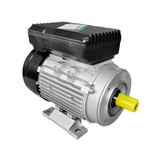
AC Torque Motor
AC Torque Motor is designed to provide a high starting torque and a relatively constant torque over a wide range of speeds. These motors typically have a relatively large inductive reactance, which results in a significant phase lag between the current and the voltage. The phase angle in an AC torque motor can be in the range of 60 - 80 degrees, depending on the motor's design and load conditions.
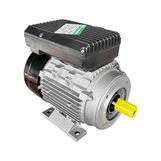
AC Induction Motor Single Phase
AC Induction Motor Single Phase is one of the most common types of 120V AC motors. In a standard single - phase induction motor, the main winding and the auxiliary winding have different phase angles. The auxiliary winding, which is often used for starting, has a phase angle that is shifted from the main winding by using a capacitor. This phase shift creates a rotating magnetic field that allows the motor to start. The phase angle between the two windings can be around 90 degrees, which is ideal for generating a strong starting torque.
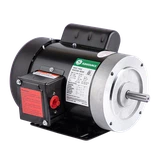
Small Single Phase AC Motor
Small Single Phase AC Motor is commonly used in household appliances and small - scale industrial applications. These motors are designed to be compact and energy - efficient. The phase angle in small single - phase AC motors is usually optimized to achieve a good balance between starting torque and power factor. Depending on the design, the phase angle can range from 30 - 60 degrees.
Measuring and Controlling the Phase Angle
Measuring the phase angle of a 120V AC motor can be done using specialized instruments such as a power analyzer or an oscilloscope. A power analyzer can directly measure the voltage, current, and phase angle, as well as calculate the power factor and other electrical parameters. An oscilloscope can be used to visualize the voltage and current waveforms and measure the phase difference between them.


Controlling the phase angle is often achieved through the use of power electronics. For example, variable frequency drives (VFDs) can be used to adjust the frequency and voltage supplied to the motor, which in turn affects the phase angle. By controlling the phase angle, the motor's performance can be optimized, resulting in improved efficiency, reduced energy consumption, and better starting and running characteristics.
Conclusion and Call to Action
Understanding the phase angle of a 120V AC motor is essential for anyone involved in the design, operation, or maintenance of these motors. As a supplier of 120V AC motors, we are committed to providing high - quality motors with optimized phase angles and performance. Our team of experts can assist you in selecting the right motor for your specific application and provide technical support to ensure that your motor operates at its best.
If you are in the market for a 120V AC motor, whether it's an AC Torque Motor, an AC Induction Motor Single Phase, or a Small Single Phase AC Motor, we invite you to contact us for a detailed discussion. We can provide you with product specifications, performance data, and pricing information. Let's work together to find the perfect motor solution for your needs.
References
- Fitzgerald, A. E., Kingsley, C., & Umans, S. D. (2003). Electric Machinery. McGraw - Hill.
- Chapman, S. J. (2012). Electric Machinery Fundamentals. McGraw - Hill.
- Dorf, R. C., & Svoboda, J. A. (2010). Introduction to Electric Circuits. Wiley.